It's beginning to look a lot more like Christmas around here - garland has been hung in the streets, the weather is that perfect "winter weather," and the food in the markets are becoming a whole lot more gingery. Since the Danes don't celebrate pilgrims taking the Mayflower across new water, they engage in Christmas activities quite early in the winter.
A custom that the Danes have made their own in the Christmas season is that of Julefrokost, or Christmas lunch. It is an informal occasion that bears more resemblance to the medieval traditions of the carnival than to a Christian feast. People have the chance to let their hair down, drink too much, and generally engage in activities that might at other times be frowned upon. These occasions are held by friends, families, and employers, and most Danes have a pretty hectic social calendar at this time of the year as a result.
I am looking forward to the few Julefrokost I have already been invited to. And it is nice starting Christmas celebrations early, considering most of the streets are well lit with Christmas lights which helps ease the darkness of the sky at around three in the afternoon.
14 November 2010

13 November 2010
The Dannebrog
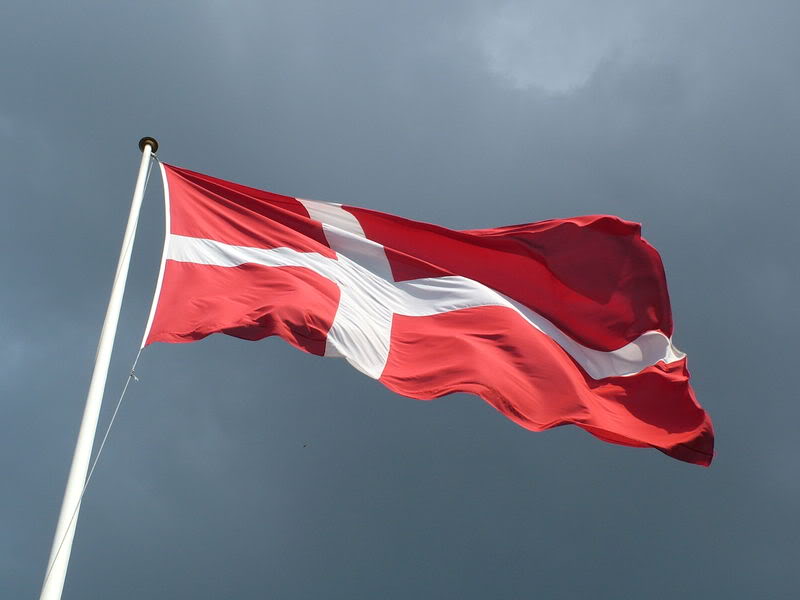
There is a lovely legend about the Danish flag, or Dannebrog, meaning “red cloth,” that states that it fell from heaven during a battle in Estonia on June 15, 1219. It was picked up by the Danish Bishop Anders, and the Estonians, seeing this as a sign from God and realizing that the fight was lost, surrendered and promptly converted to Christianity.
In reality the flag was the banner of the German order of knights known as they Knights of Saint John, later the Knights of Malta, which tore itself loose during the battle and landed among its Danish contingent. To celebrate the victory King Valdemar adopted the flag as the symbol of the Danish army and it was later adopted as the national flag of Denmark. The event is still celebrated today and on June 15, Valdemar’s Day, the flag is flown across the country. The Dannebrog also shares the distinction with the British Union Jack, the Stars and Stripes, and the Tricolore, of being one of the few national flags to have its own name.
Excerpt from “A quick guide to customs and etiquette: Denmark.”
12 November 2010
Time for bed....
Well, it's about 6 p.m. here and I am ready to hit the sack. It's been a lot of late nights and all-nighters this week finishing up some work for my project. I had a constructive critique today, so I am excited to see where the project goes throughout the semester. It's hard for me to stay awake during all-day long critiques at Iowa State after nights of no sleep, but it's even harder here considering most of the critiques are in Danish.
Next week my department's exhibition will open over our work completed in Venice. I am excited to see all the projects and photographs. Check back to see for yourself.
Have a good weekend all.
Skål!
11 November 2010
Happy Veteran's Day....
Today, I salute all veterans that have and are currently serving the great country of the United States of America.


This picture I captured during the summer of 2009 while on a Washington D.C. vacation with Sara and Shaun.
10 November 2010
Learn some basic Danish...
Hello: Goddag/Hej (polite/informal)
Goodbye: Farvel
Yes: Ja
No: Nej
Thank you: Tak
Excuse me: Undskyld
And the word I have used the most since arriving in Denmark:
Cheers: Skål
09 November 2010
Danish Immigration Museum in Elk Horn, Iowa
The next time your loved one and you are driving on a road trip to the Rocky Mountains from Iowa, make sure to convince them to stop at the Danish Immigrant Museum in Elk Horn. The museum is situated along the I-80 corridor midway between Des Moines, Iowa and Omaha, Nebraska. Elk Horn is one of the many small communities in the Midwest settled by a large numbers of Danes who came to this country.


The museum's artifact collection of over 35,000 artifacts is diverse and wide ranging. There are family heirlooms brought from Denmark, remarkable examples of needlework, tools of early immigrant tradesmen and memorabilia from Danish-American clubs and organizations. Many of the items on display are treasures which have been passed down through the generations in Danish families.
Oh, and make sure to stop at the Danish pastry shop on the way into town. There will be a group of old Danish ladies enjoying coffee, they will stop and stare at you - but just order the "spandauer" and all should be fine.


The museum was interesting and a good break after driving about 3 hours on our 15-hour journey to the Rocky Mountains. The restroom facilities were superb. We also did not have to pay to enter the museum, because I claimed I was a landscape architecture student - and the elderly Danish woman said, "Well since you are just looking at the architecture - I won't charge you." I then practiced some Danish and we were on our way.The museum was founded in 1983 to preserve the history of Danish immigration to America. In 1994 the first phase building, reminiscent of Danish architecture was completed, housing significant artifacts important to the interpretation of the Danish immigration story.
The museum's artifact collection of over 35,000 artifacts is diverse and wide ranging. There are family heirlooms brought from Denmark, remarkable examples of needlework, tools of early immigrant tradesmen and memorabilia from Danish-American clubs and organizations. Many of the items on display are treasures which have been passed down through the generations in Danish families.
Oh, and make sure to stop at the Danish pastry shop on the way into town. There will be a group of old Danish ladies enjoying coffee, they will stop and stare at you - but just order the "spandauer" and all should be fine.
08 November 2010
Danes on telling time…
"...One of the greatest sources of confusion in the area of timekeeping stems from some Danes’ habit of translating directly from Danish to English while speaking. The source of this confusion is the Danish way of saying the time. If a Dane arranges to meet you at “half twelve” in the afternoon, and you arrive to find a rather irritated Scandinavian waiting for you (if he or she bothered to wait at all, that is), the explanation is quite simple.
When Danes say “half twelve,” they mean half an hour to twelve, and not half past, as has become the norm in the English-speaking world. They will also give the time as being, for example, “five minutes to half twelve” or “five minutes past half twelve.”..."
Excerpt from “A quick guide to customs and etiquette: Denmark.”
I always make sure to confirm times when meeting with or scheduling an arrangement with a Dane. It can be extremely confusing.
Today was spent at lecture. And then I headed to the United States Embassy in Copenhagen to inform them of my stolen pocketbook, as well as the police station to fill out a police report regarding the incident. All my cards are canceled - and I thank my mom for the worrisome and trouble back home of canceling all my other cards and identities.
Subscribe to:
Posts (Atom)